

 />i



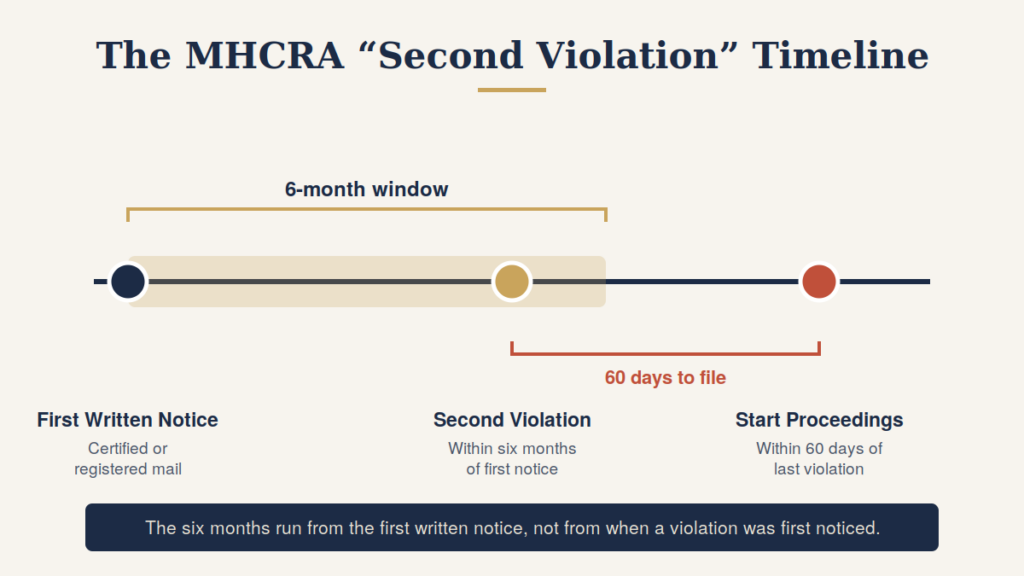
As described in earlier blogs, under the Manufactured Home Community Rights Act (“MHCRA”), eviction based on a rule or lease violation generally requires a second or subsequent violation within six months of the first written notice.
That means that tracking notices and treating violations with formality is important. If the first notice is vague, improperly mailed, unsupported by evidence, inconsistently enforced, or treated like a verbal warning instead of a documented event, the community may have difficulty evicting if the resident continues to violate the rules.
The MHCRA’s Timeline
Section 4 of the MHCRA permits eviction for s “second or subsequent violation” of the rules or lease within a six-month period. The statute also requires written notice of the particular violation to be sent by certified or registered mail. The notice also has particular requirements.
The critical point is that the six-month period runs from the date of the first written notice, not simply from the date that management first noticed the violation. If another violation occurs within that six-month window, eviction proceedings may be commenced. The owner must then act promptly: the MHCRA provides that proceedings must be started within 60 days of the last violation or breach.
Therefore, management should keep records of when violations were first observed, when notice was sent via mail, the status of delivery, and the dates of any later violations. Although not required by the MHCRA, a best practice is to also send the notice via first-class mail or tape it to the resident’s door.
Avoid Informal Enforcement
While management may be tempted to attempt to enforce rules informally through verbal warnings, community announcements, or resident portals, that may only serve to prolong the process because no six-month window has commenced.
A written notice should be prepared after the first violation. If management wants to develop policies of leeway, management is free to allow residents extra time to cure the violation, but it is not advisable to avoid formal enforcement entirely.
Notices should also contain as much specificity as possible. The notice should quote rule language and, if possible, provide specific examples to identify the source of the violation. Avoid vague or general phrases such as “poor housekeeping” or “nuisance conduct” even if that is the rule language.
Enforce Consistently
The MHCRA does not allow evictions for violations unless the rule is uniformly enforced against residents. A resident may therefore defend a rule-based eviction by arguing that management selectively enforces the rule, tolerates the same conduct by others, or provides others leeway that was not provided to the resident being evicted. This is all the more reason to treat every violation with formality.
Uniform enforcement does not mean every violation must produce the same result regardless of circumstances. Management may distinguish between different facts, severity levels, evidence, safety concerns, prior history, or cure efforts. But those distinctions should be documented and applied consistently.
Communities should maintain practices that support uniform enforcement:
- Have a written copy of the community rules and regulations posted in the community
- Keep records of rule changes and distribution to residents
- Document complaints for all residents
- Use standard form notices for comparable violations
- Record the reason for any exception, extension, or alternative resolution
- Apply the same rules to owners, tenants, guests, and household members when the rules so provide
Pet restrictions, parking, exterior maintenance, storage, vehicle conditions, and noise are particularly vulnerable to selective-enforcement arguments. Informal exceptions may feel practical in the moment, but they can undermine a later claim that a rule is uniformly enforced. Therefore, management should make efforts to be aligned in policies and communicate them effectively to the individuals with enforcement responsibilities.
A future blog will focus on things to consider in creating policies for consistent enforcement.
Evidence, Evidence, Evidence!
Do not wait for a failure to cure a violation to start documenting. By that point, management (or other residents if they were the source of the initial notice) may no longer remember details, facts become easier to dispute, and photographs or documents may be unavailable.
Each violation file should contain contemporaneous evidence, if available, such as dated photographs or video, incident reports, written complaints from residents or others, any statements from the resident, and any inspection records, maintenance reports, or security logs.
Photographs should establish context. A close-up image of debris, an unregistered vehicle, or a prohibited structure may not show where it was located. Include wide-angle photographs showing the lot, address, landmarks, or other identifying features, along with detailed close-up images.
Resident complaints may help establish notice to management and identify potential witnesses, but complaints alone can be weak proof. When possible, management should independently inspect the lot or condition, document what it observed, and preserve the names and contact information of witnesses.
Maintain A Log
A violation log can either be a separately maintained document or a log that is part of a residents individual file. While there are pros and cons to every method, the important takeaway is to have a record.
A useful log should identify the resident/lot involved, the rule implicated, the information about the incident (date, time, and events), the source of the report (e.g. management or another resident), any evidence, and any later violations.
Given that all documentation is subject to presentation in court, any logs or entries should be factual, neutral, and professional. For example, “Two inoperable vehicles observed in the driveway at Lot 17 at 9:10 a.m.” is more useful than “resident continues to ignore management.” The first entry can be supported by testimony and photographs and compared to the language of the rules and regulations. The second is closer to an opinion.